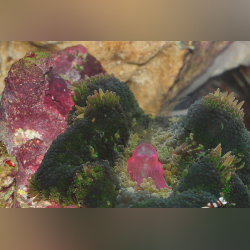
Rafi Amar, Israel

Info
Ancylocaris brevicarpalis Schenkel, 1902
The peacock-eyed sea anemone shrimp Ancylocaris brevicarpalis is an obligate symbiont of various sea anemones. These shrimp are immune to the sea anemones’ stinging cells.
This plump shrimp, with orange spots on its tail outlined in black, is often seen in large sea anemones along coastlines within its range. Usually, a pair can be seen in a single anemone, living safely among its tentacles. Occasionally, juveniles are also present.
Characteristics: Up to about 4 cm. Body nearly transparent, especially in the smaller males. Long, transparent claws with purple stripes. The female is often larger and more brightly colored, with more and larger white spots on the back, along the abdomen, and at the base of the tail. The male can be completely transparent except for the eye spots on the tail. Some also have a white tail and a white stripe between the eyes. In both males and females, the tail has 5 orange eye spots surrounded by black.
Scientific statistical analyses of males and females have shown that, on average, the sexes are the same size.
Ancylocaris brevicarpalis shows no sexual dimorphism with regard to body size; the frequency distributions of body size for males and females overlapped considerably, and the average body size of males and females did not differ statistically.
The size of the claws was only slightly larger in males than in females.
At low tide, they are easier to spot at night when they are still somewhat active. During the day, they often remain hidden beneath the anemone.
There are four distinct embryonic stages in 4LT: Stage 1, freshly laid embryos, light green in color and without a visible blastoderm; Stage 2, blastoderm, clearly recognizable, without eye development; Stage 3, embryos containing 2/3 of the original yolk, with visible eye spots and limbs bearing small orange spots; Stage 4, fully developed embryos, translucent white in color, yolk almost depleted, eyes protruding, and abdomen free from the cephalothorax.
It has been demonstrated that Ancylocaris brevicarpalis is a gonochorous species, and as such, individuals settle in the benthos, grow, mature, and reproduce. They remain either male or female throughout their entire lives and do not undergo sex change.
What does Ancylocaris brevicarpalis eat?
Anemone shrimp do not appear to eat either the host anemone or the anemone’s fluids. Instead, they presumably seek shelter in the anemone and feed on food scraps. The shrimp have often been observed “hanging” with their claws extended over the edge of their anemone home.
In the ocean, these shrimp prefer the following sea anemones:
Stichodactyla gigantea
Stichodactyla haddoni
Radianthus magnifica (Radianthus magnifica)
Radianthus crispa (Radianthus crispa)
Cryptodendrum adhaesivum
Entacmaea quadricolor
Radianthus doreensis
Phymanthus sp.
You should be careful if you have larger fish, as it’s quite possible that some fish might view these small shrimp as food!
Synonyms:
Ancylocaris hermitensis (Rathbun, 1914) · unaccepted > superseded combination
Harpilius latirostris Lenz, 1905 · unaccepted > junior subjective synonym
Palaemonella aberrans Nobili, 1904 · unaccepted > junior subjective synonym
Palaemonella amboinensis Zehntner, 1894 · unaccepted
Periclimenes brevicarpalis (Schenkel, 1902) · unaccepted > superseded combination
Periclimenes hermitensis Rathbun, 1914 · unaccepted > junior subjective synonym
Periclimenes potina Nobili, 1905 · unaccepted > junior subjective synonym
The peacock-eyed sea anemone shrimp Ancylocaris brevicarpalis is an obligate symbiont of various sea anemones. These shrimp are immune to the sea anemones’ stinging cells.
This plump shrimp, with orange spots on its tail outlined in black, is often seen in large sea anemones along coastlines within its range. Usually, a pair can be seen in a single anemone, living safely among its tentacles. Occasionally, juveniles are also present.
Characteristics: Up to about 4 cm. Body nearly transparent, especially in the smaller males. Long, transparent claws with purple stripes. The female is often larger and more brightly colored, with more and larger white spots on the back, along the abdomen, and at the base of the tail. The male can be completely transparent except for the eye spots on the tail. Some also have a white tail and a white stripe between the eyes. In both males and females, the tail has 5 orange eye spots surrounded by black.
Scientific statistical analyses of males and females have shown that, on average, the sexes are the same size.
Ancylocaris brevicarpalis shows no sexual dimorphism with regard to body size; the frequency distributions of body size for males and females overlapped considerably, and the average body size of males and females did not differ statistically.
The size of the claws was only slightly larger in males than in females.
At low tide, they are easier to spot at night when they are still somewhat active. During the day, they often remain hidden beneath the anemone.
There are four distinct embryonic stages in 4LT: Stage 1, freshly laid embryos, light green in color and without a visible blastoderm; Stage 2, blastoderm, clearly recognizable, without eye development; Stage 3, embryos containing 2/3 of the original yolk, with visible eye spots and limbs bearing small orange spots; Stage 4, fully developed embryos, translucent white in color, yolk almost depleted, eyes protruding, and abdomen free from the cephalothorax.
It has been demonstrated that Ancylocaris brevicarpalis is a gonochorous species, and as such, individuals settle in the benthos, grow, mature, and reproduce. They remain either male or female throughout their entire lives and do not undergo sex change.
What does Ancylocaris brevicarpalis eat?
Anemone shrimp do not appear to eat either the host anemone or the anemone’s fluids. Instead, they presumably seek shelter in the anemone and feed on food scraps. The shrimp have often been observed “hanging” with their claws extended over the edge of their anemone home.
In the ocean, these shrimp prefer the following sea anemones:
Stichodactyla gigantea
Stichodactyla haddoni
Radianthus magnifica (Radianthus magnifica)
Radianthus crispa (Radianthus crispa)
Cryptodendrum adhaesivum
Entacmaea quadricolor
Radianthus doreensis
Phymanthus sp.
You should be careful if you have larger fish, as it’s quite possible that some fish might view these small shrimp as food!
Synonyms:
Ancylocaris hermitensis (Rathbun, 1914) · unaccepted > superseded combination
Harpilius latirostris Lenz, 1905 · unaccepted > junior subjective synonym
Palaemonella aberrans Nobili, 1904 · unaccepted > junior subjective synonym
Palaemonella amboinensis Zehntner, 1894 · unaccepted
Periclimenes brevicarpalis (Schenkel, 1902) · unaccepted > superseded combination
Periclimenes hermitensis Rathbun, 1914 · unaccepted > junior subjective synonym
Periclimenes potina Nobili, 1905 · unaccepted > junior subjective synonym