


 Martin Hablützel, Schweiz


Info
Actinostephanus haeckeli Kwietniewski, 1897
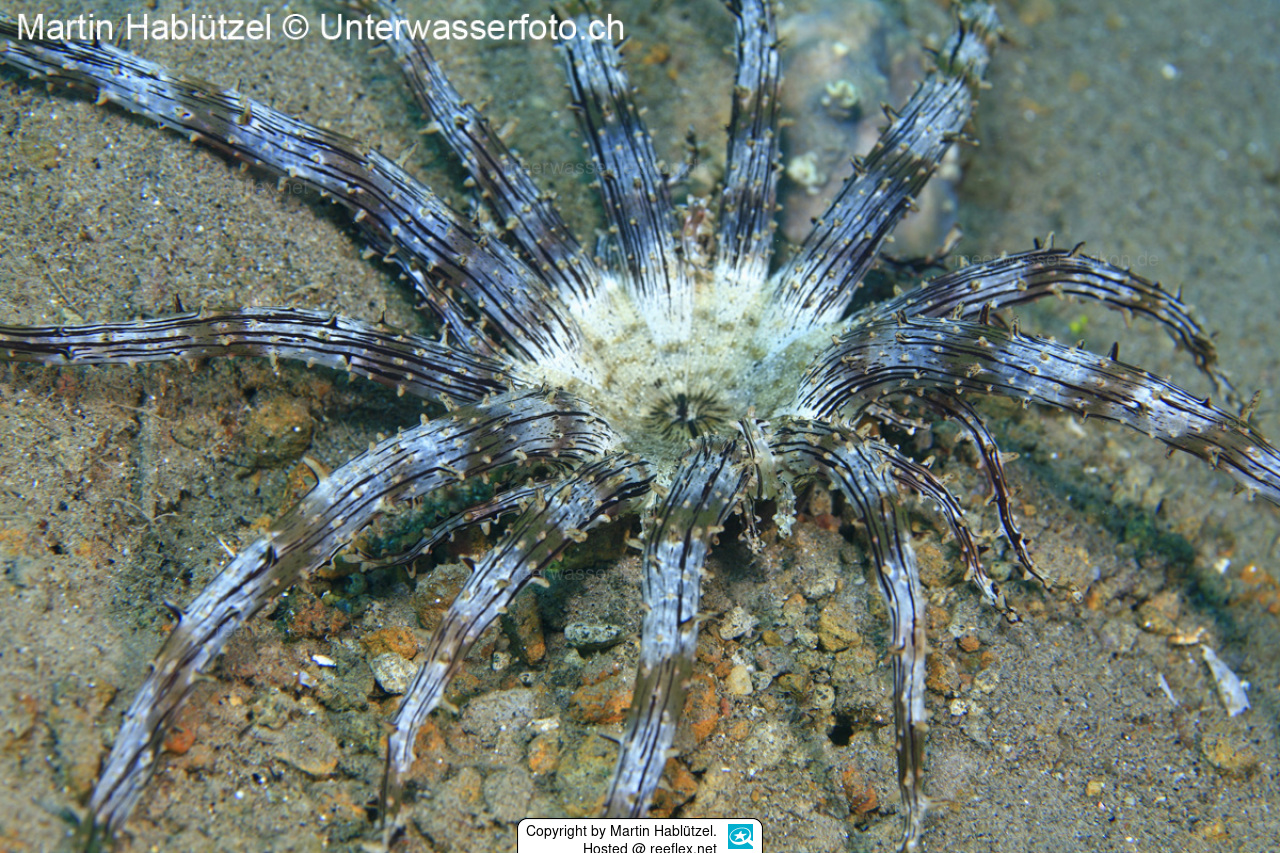
Actinostephanus haeckeli resembles a starfish or a brittle star more than an anemone. Actinostephanus haeckeli is the only species in the genus Actinostephanus, which, along with Megalactis and Actinodendron, belongs to the family Actinodendronidae, whose members are also known as fire anemones.
This bizarre-looking anemone can be found both on sandy shores and near reefs. It usually occurs solitary within a larger area. Haeckel’s anemone can retreat completely into the sand at low tide.
Characteristics: 10–20 cm in diameter. The anemone has approximately 12 long, thick, cylindrical tentacles that taper at the tips, and below them another ring of much shorter, slender tentacles. The body column is short, smooth, with regular stripes. The tentacles are studded with large, striped spines that resemble quills.
In some specimens, the tentacles and oral disc are uniformly dark brown to black, with a body column that resembles the color of the oral disc or is sometimes brick-red to light orange-red. The color fades at the base of the body column. Others have tentacles that are paler with greenish hues. These have fine radiating lines on the oral disc and an olive-green body column.
This anemone stings extremely strongly and should under no circumstances be touched!
The anemone swimming crab Lissocarcinus laevis has already been found on Actinostephanus haeckeli, using the anemone for protection.
Synonymised names:
Actinostephanus haekeli
Actinostephanus haeckeli resembles a starfish or a brittle star more than an anemone. Actinostephanus haeckeli is the only species in the genus Actinostephanus, which, along with Megalactis and Actinodendron, belongs to the family Actinodendronidae, whose members are also known as fire anemones.
This bizarre-looking anemone can be found both on sandy shores and near reefs. It usually occurs solitary within a larger area. Haeckel’s anemone can retreat completely into the sand at low tide.
Characteristics: 10–20 cm in diameter. The anemone has approximately 12 long, thick, cylindrical tentacles that taper at the tips, and below them another ring of much shorter, slender tentacles. The body column is short, smooth, with regular stripes. The tentacles are studded with large, striped spines that resemble quills.
In some specimens, the tentacles and oral disc are uniformly dark brown to black, with a body column that resembles the color of the oral disc or is sometimes brick-red to light orange-red. The color fades at the base of the body column. Others have tentacles that are paler with greenish hues. These have fine radiating lines on the oral disc and an olive-green body column.
This anemone stings extremely strongly and should under no circumstances be touched!
The anemone swimming crab Lissocarcinus laevis has already been found on Actinostephanus haeckeli, using the anemone for protection.
Synonymised names:
Actinostephanus haekeli


