Anzeige
Fauna Marin GmbH Mrutzek Meeresaquaristik Kölle Zoo Aquaristik ICP BAS

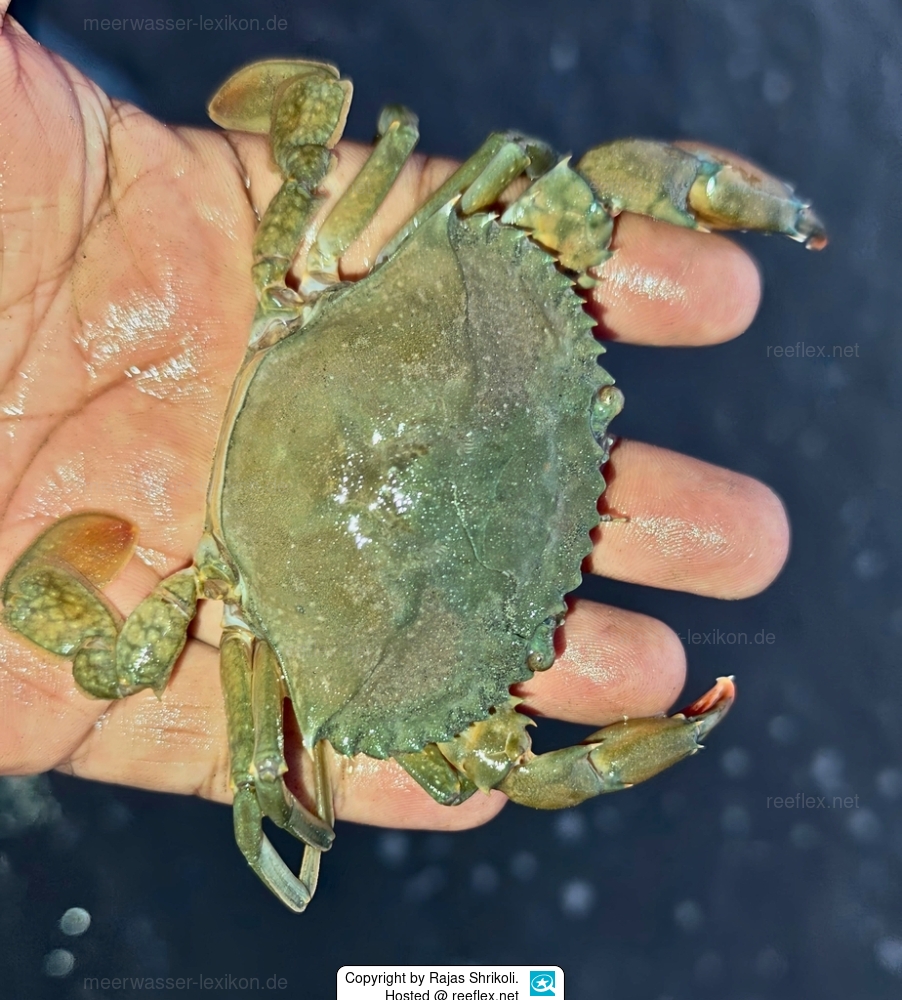
Scylla olivacea Orange Mud Crab, Brown Mud Crab

Scylla olivacea is commonly referred to as Orange Mud Crab, Brown Mud Crab. Difficulty in the aquarium: Not suitable for aquarium keeping. Toxicity: Toxic hazard unknown.


Profilbild Urheber Rajas Shrikoli, Indien

Scylla olivacea,3RPG+RHM, Daulat Nagar, Juhu, Mumbai, Maharashtra 400049, India 2025 (CC BY)


Courtesy of the author Rajas Shrikoli, Indien Rajas Shrikoli (CC BY). Please visit www.inaturalist.org for more information.

Uploaded by Muelly.

Image detail


Profile

lexID:
18381 
AphiaID:
Scientific:
Scylla olivacea 
German:
Orange Schlammkrabbe, Olivegrüne Schwimmkrabbe, Braune Schwimmkrabbe 
English:
Orange Mud Crab, Brown Mud Crab 
Category:
Krabi 
Family tree:
Animalia (Kingdom) > Arthropoda (Phylum) > Malacostraca (Class) > Decapoda (Order) > Portunidae (Family) > Scylla (Genus) > olivacea (Species) 
Initial determination:
(Herbst, ), 1796 
Occurrence:
Andaman and Nicobar Islands, Arafura Sea, Australia, China, Coral sea (Eastern Australia), India, Japan, Kenya, Pakistan, Papua, Taiwan, Thailand, Timor Sea 
Marine Zone:
Subtidal, sublittoral, infralittoral, deep zone of the oceans from the lower limit of the intertidal zone (intertidal) to the shelf edge at about 200 m water depth. neritic. 
Sea depth:
Meter 
Habitats:
Coastal waters, Estuaries (river mouths), Intertidal zone, Tidal Zone, Mangrove Zones, Seawater, Sea water, Unconsolidated muddy grounds 
Size:
up to 7.09" (18 cm) 
Weight:
1.5 kg 
Temperature:
°F - 82.4 °F (°C - 28°C) 
Food:
Algae (Algivore), Carnivore, Carrion, Invertebrates, omnivore, Predatory, Zoobenthos 
Difficulty:
Not suitable for aquarium keeping 
Offspring:
Possible to breed 
Toxicity:
Toxic hazard unknown 
CITES:
Not evaluated 
Red List:
Not evaluated (NE) 
Related species at
Catalog of Life
:
 
Author:
Publisher:
Meerwasser-Lexikon.de
Created:
Last edit:
2026-05-30 13:14:32 

Captive breeding / propagation

The offspring of Scylla olivacea are possible. Unfortunately, the number of offspring is not large enough to cover the demand of the trade. If you are interested in Scylla olivacea, please ask your dealer for offspring. If you already own Scylla olivacea, try breeding yourself. This will help to improve the availability of offspring in the trade and to conserve natural stocks.

Info

Scylla olivacea (Herbst, 1796)

Portunid crabs are characterised by the flattening of the fifth pair of legs into broad paddles, which are used for swimming. This ability, together with their strong, sharp claws, allows many species to be fast and aggressive predators.

Synonymised names
Cancer olivacea Herbst, 1796 · unaccepted > superseded combination

External links

  1. EOL (en). Abgerufen am 30.05.2026.
  2. Fish for the future (en). Abgerufen am 30.05.2026.
  3. National Library of Medicine (en). Abgerufen am 30.05.2026.
  4. sealifebase (en). Abgerufen am 30.05.2026.

Pictures

Commonly


Husbandry know-how of owners

0 husbandary tips from our users available
Show all and discuss